
Review of 1959 season
The 1959 season became a turning point in the history of Formula 1, marking the end of the era of front-engined dominance and bringing well-deserved laurels to John Cooper’s team, which overcame Scuderia Ferrari in a hard-fought battle to win both the Drivers’ and Constructors’ Championships. By committing to the rear-engine concept, John Cooper spent several years methodically developing his cars, and ultimately his vision proved correct: Cooper machines proved to be considerably lighter than those of their rivals, granting them advantages in speed, handling, as well as tyre and fuel consumption.

The only real weakness of the Cooper design remained the underpowered Coventry Climax engines: as recently as the previous year their displacement was just 2.2 litres, leaving the team with little chance of challenging the front runners. However, at the start of 1959 the Coopers received new 2.5-litre Climax engines, which were “only” about 50 horsepower down on the Ferrari units — and that proved sufficient for the Surbiton cars to fully realise their potential and achieve remarkable success on their way to the top of Formula 1.

Yet the drivers themselves undoubtedly played no less important a role in the Cooper’s success, their phenomenal performances becoming perhaps the greatest revelation of the season. With the new Cooper T51 at his disposal, team leader Jack Brabham - who over the previous years had managed to collect only a handful of points — announced himself at the very start of the season with a magnificent victory in Monaco, which was immediately followed by podium finishes in the Netherlands and France, and then by another, equally convincing triumph in Great Britain.
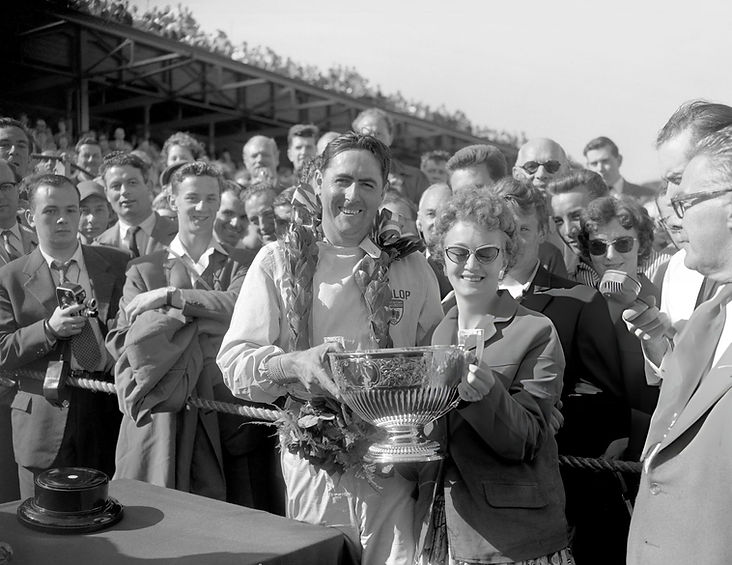
This string of successes quickly established the Australian as the leading contender for the championship title, a status he managed to retain right up to the final round of the season, despite two consecutive setbacks in Germany and Portugal. At the decisive finale in Sebring, fate once again smiled on Jack, removing his principal rivals from the fight within the opening laps, so, even when confronted with fuel starvation on the final lap, it was he who ultimately claimed the crown - after pushing his car the remaining 400 meters to the finish line.

Equally impressive throughout the season was Cooper’s young newcomer, Bruce McLaren.

Already at the opening round in Monaco, Bruce scored his first two championship points, added another two in France, and then delivered an even stronger performance in Great Britain, where he finished on the podium and set the fastest lap of the race.

In addition, McLaren thrilled spectators throughout the season with his superb starts: rarely shining in qualifying, he would turn the opening metres of the race into a spectacle, storming past a host of cars in one sweeping charge. The real highlight, however, came at the season finale in the United States: when Brabham ran out of fuel on the final lap, it was McLaren who inherited the lead from his teammate and took it all the way to the finish, thus becoming the youngest Formula 1 Grand Prix winner at the time!

While Brabham and McLaren grabbed the headlines with their remarkable achievements, Cooper’s third driver, Masten Gregory, may have seemed less prominent; yet his performances were highly commendable, marking his finest year in Formula 1.

Despite failing to score a win, Gregory was by no means slower than McLaren and improved steadily throughout the season, with his impressive performances in Germany and Portugal — the latter culminating in a superb second place — clearly demonstrating his growth.

Unfortunately, a heavy crash in the Tourist Trophy sports-car race dashed the American’s hopes of finishing the season on a strong note, and, forced to miss the final two rounds, Masten ultimately had to settle for only ninth place in the overall standings.
Meanwhile, in addition to the works team, the Cooper T51s were also run by Rob Walker’s private outfit, and it must be said that its lead driver, Stirling Moss, once again demonstrated why he was considered the strongest driver in the field.

Although Brabham proved to be a very worthy rival, it was undoubtedly Moss who deserved the title more than anyone in 1959, yet frequent mechanical troubles once again deprived him of any real chance of success. The Achilles’ heel of Walker’s cars proved to be the gearbox: while the factory Coopers used the proven four-speed Citroën transmission, Rob Walker’s machines were fitted with a less reliable five-speed Colotti unit, whose failures cost Moss two certain victories at the start of the season — in Monaco and the Netherlands.

Disappointed by these setbacks, Stirling even staged something of a protest at the next two rounds, temporarily taking the wheel of a BRM entered by his father’s team. The move, however, brought little success: in France the Englishman was disqualified after spinning on lap 43, while in Great Britain he could manage only second place, unable to match Brabham’s pace.

With the Australian already enjoying a substantial lead in the standings, Moss’s title hopes had all but vanished, and even back-to-back victories in Portugal and Italy failed to alter the situation significantly: at the final round Stirling once again suffered a transmission failure, which ultimately relegated him to third place in the championship.

Despite not being particularly noted for outright speed, Walker’s second driver, Maurice Trintignant, relied on remarkable consistency, and thanks to podium finishes in Monaco and the United States, the experienced Frenchman rose to an impressive fifth place in the standings, ahead of Cooper’s two young talents, Bruce McLaren and Masten Gregory.

The Coopers' main rival that season was Scuderia Ferrari, which, it must be admitted, did everything in its power to retain the championship title. Yet the odds were clearly stacked against the reds, and their only real advantage lay in their considerably stronger engines, which at the time produced around 295 horsepower.

Thanks to this edge, the Scuderia still managed to claim victories on the championship’s two fastest circuits — Reims in France and Avus in Germany — with Tony Brooks taking center stage as the leading force for the reds.

However, having faltered on the twisty circuits in the Netherlands and Portugal, and missing the British Grand Prix due to a strike by Italian steelworkers, Brooks was unable to replicate the previous year’s success of his compatriot Mike Hawthorn and ultimately had to settle for the runner-up spot in the championship.
Meanwhile, at the start of the season, Jean Behra was widely regarded as one of the main title contenders after joining the Scuderia line-up that year; however, things went awry for the Frenchman from the very start. After losing the opportunity to win in Monaco due to an engine failure, he managed to score only two points in the Netherlands, followed by a memorable race at Reims, where his car again let him down — the engine failed just as he had heroically fought his way up to second place from the back of the field.

Enraged by his relentless run of misfortune, the hot-tempered Frenchman went so far as to accuse the team of sabotage, and the consequences were swift — Behra was promptly shown the door.

By a tragic twist of fate, that very Grand Prix proved to be the last in his life: while taking part in a support race ahead of the German round, Jean crashed his Porsche into a barrier guarding the banking in the northern section of Avus and suffered fatal head injuries after striking a flagpole.

Although he never managed to win a Formula 1 race, Behra nevertheless remained in the memory of his contemporaries as one of the finest drivers of his era, and his death undoubtedly became the most tragic moment in motorsport that year.
Unlike Behra, Scuderia’s third driver, Phil Hill, enjoyed a relatively successful first full season in Formula 1, and despite failing to claim a victory, three podium finishes in France, Germany and Italy allowed the American to secure an impressive fourth place in the standings.

At the same time, another American newcomer, Dan Gurney, who made his Formula 1 debut with Ferrari that year, proved almost as impressive. Despite contesting only four Grands Prix, he finished two of them on the podium and was among the main contenders for victory at the German Avus, and with 13 points to his name, the American ultimately completed his first championship in a very respectable seventh place.

Meanwhile, this year also proved to be a landmark for BRM: after four years of developing the P25 cars, the British team finally achieved its maiden triumph, when Jo Bonnier delivered a superb victory at the Dutch Grand Prix.

Unfortunately, BRM failed to build on that success, and, unable to compete with the faster Cooper and Ferrari cars, Bonnier and his teammate Harry Schell managed to bring Alfred Owen’s team only four points finishes, which ultimately secured them no more than third place in the Constructors’ Championship.

However, compared with the results of the other two British teams, Lotus and Aston Martin, BRM’s achievements appeared quite impressive. Entering their second season in Formula 1, the Lotus 16 cars still failed to find the necessary pace, a shortcoming made all the more evident by Cooper’s remarkable success with the same Coventry Climax engines, while their reliability proved even poorer. Lotus’s lead driver, Graham Hill, faced one problem after another in nearly every Grand Prix and, having failed to score a single point, chose to part ways with Chapman’s team before the end of the championship to join BRM the following year.

Meanwhile, Lotus newcomer Innes Ireland fared somewhat better, scoring two points finishes in the Netherlands and the United States; however, over the course of the season he also encountered numerous technical problems, most notably with the gearbox.
.jpg)
However, the season’s greatest disappointment was undoubtedly the debut of the renowned British marque Aston Martin.

The reason for this failure was obvious: having focused his efforts on the sports car racing program, David Brown introduced his Formula 1 cars to the track roughly two years too late, by which time the lightweight, agile, rear-engined Coopers were already in command. With a front-engine layout, the Aston Martin DBR4s were burdened by excessive weight, while their engines, producing only around 10 more horsepower than the Coventry Climax units, offered little speed advantage and proved rather unreliable.

As a result, none of the Aston Martin drivers managed to score any points during the season, and the team’s only bright moment came when Roy Salvadori qualified second at Silverstone, a position that, however, failed to yield success due to a poor start.

Alternative driver standings

Alternative team standings
