
1959 Monaco Grand Prix
The opening round of the 1959 Formula-1 World Championship took place on May 10 in Monaco, on the legendary circuit winding through the narrow streets of the principality. Compared to the previous year, the track remained unchanged, still measuring 3.145 km in length, while the drivers faced the challenge of completing 100 laps.

With the Argentine GP cancelled, the Monaco round became the opening event of the World Championship and the first opportunity for fans to see the new F1 cars and their favourite drivers in action. Meanwhile, major developments in the off-season - the withdrawal of the Vanwall team, as well as the retirement of newly crowned World Champion Mike Hawthorn (who would tragically lose his life in a road accident shortly afterwards) — led to significant changes in teams line-ups, further fueling anticipation for the coming contest.
For Scuderia Ferrari, the previous year had been especially difficult: the team lost not only Hawthorn, but also Luigi Musso and Peter Collins, who were killed in the French and German Grands Prix respectively, and as a result, their driver roster for the new season was almost unrecognizable. Joining the team were former Vanwall and BRM drivers Tony Brooks and Jean Behra, along with Cliff Allison from Lotus, while the only survivor of the previous line-up was the American, Phil Hill.


At the same time, by the opening round, they in Scuderia managed to prepare only three updated Ferrari 246 Dinos, which were entrusted to Brooks, Behra and Hill, while the less experienced Allison was given a Formula-2 Ferrari 156 fitted with a 1.5-liter V6 engine. As for the 246s, their main distinction from last year’s cars lay in the updated rear suspension, which now featured coil springs and telescopic dampers, as well as a new braking system with disc mechanisms on all four wheels. In addition, for Monaco circuit specifically, the scarlet cars were fitted with shorter and wider nose fairings, designed to improve engine cooling and reduce the risk of damage in close contact.

Meanwhile, despite the absence of the Vanwall team, British machinery still dominated the pit-lane, with the most numerous contingent coming from Surbiton. John Cooper’s works team fielded at Monaco three of their latest T51s – two fitted with the new 2.5-litre Climax engines and one still carrying last year’s 2.2-litre power unit.

The first two cars were entrusted to team leader Jack Brabham and the young but already experienced Masten Gregory, while the third, equipped with the less powerful engine, went to the team’s rookie – 21-year-old New Zealander Bruce McLaren.

At the same time, John Cooper’s works team was not the only one to boast the brand-new T51s in Monaco — Rob Walker’s private outfit also fielded nearly identical cars.

Walker managed to put none other than Stirling Moss behind the wheel of one of the cars, who, left out of work after Vanwall's unexpected withdrawal from motorsport, decided to join forces with Rob's private stable this season, while the second car was given over to Grand Prix racing veteran Maurice Trintignant.

In addition, another hybrid Cooper, combining last year’s T45 chassis with a 2.5-liter Maserati engine, was entered by Tommy Atkins’ private team, with their sole driver being former John Cooper's racer Roy Salvadori.

Rounding out the picture were four more Formula-2 Coopers with 1.5-liter Climax engines: two of them belonged to Equipe Nationale Belge and were driven by Lucien Bianchi and Alain de Changy; another was piloted by Ivor Bueb of United Racing Stable, while the last one was entered by private driver Jean Lucienbonnet.
Apart from the Cooper, the opening round of the championship also featured two other British works teams, BRM and Lotus. Alfred Owen’s squad was represented here by three drivers - Harry Schell, Jo Bonnier, and Ron Flockhart - who took to the track in the trusty BRM P25s, outwardly and technically almost indistinguishable from last year’s cars.
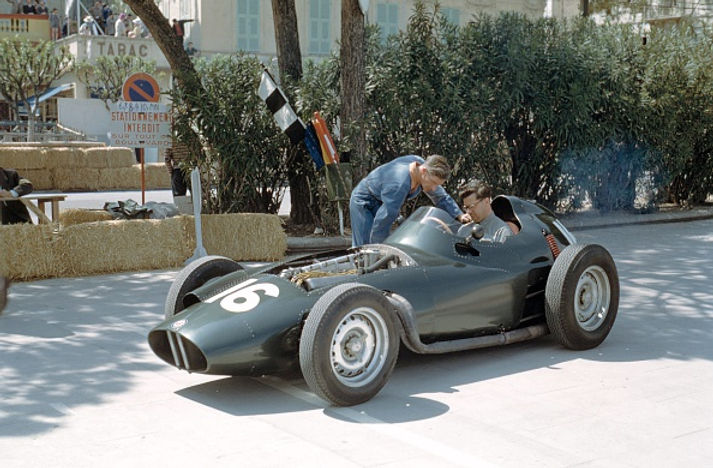

As for Colin Chapman’s team, their last year's Lotus 16s were now fitted, like the factory Coopers, with the new 2.5-liter Climax engines, one of which, as in the previous season, was entrusted to Graham Hill, while the other went to American newcomer Pete Lovely, who replaced Cliff Allison in the team.

In addition, another Lotus 16 with a 1.5-liter Climax engine was entered by private racer Bruce Halford.
Alongside the Italian and British works teams, the opening round in Monaco also saw a rather unexpected appearance from the German team Dr. Ing. F. Porsche, whose sole car immediately drew heightened attention from both rivals and the public. The basis for this bolid was the new sports car from the Stuttgart company Porsche 718 RSK with a standard 1.5-liter Spyder engine, which was converted by German engineers into a monoposto, and its main highlight was an unusual six-speed gearbox, in which the first gear was used exclusively for starting off.


The task of bringing this car to the Grand Prix grid was entrusted to the most promising German driver of the era, Wolfgang von Trips, who, having left Scuderia Ferrari, took on the role of team leader in the German stable. At the same time, this Porsche was by no means the only one in the Monte Carlo pit lane: a very similar car, with a slightly modified body and a more conventional five-speed gearbox, was entered by Jean Behra. The Frenchman graciously gave the driving seat in this car to Italian Maria Teresa de Filippis, the only female driver of that era with experience in Formula 1 racing.

Finally, the entry list was completed by two more private drivers, Giorgio Scarlatti and André Testut, who took to the track behind the wheel of outdated Maserati 250Fs.
Qualification
As in previous years, the regulations for the Monaco Grand Prix allowed only 16 cars on the starting grid, which meant that a third of the drivers - eight out of the twenty-four entries - risked being left out already after qualifying. Naturally, this added a particular edge to the season’s opening competition, and over the three days of practice, spectators witnessed the most intense battle for every position on the starting grid. At the same time, it quickly became clear that the new, more powerful Cooper T51s were in no way inferior in speed than the champion Ferraris, and, as a result, the main fight for pole position unfolded between drivers representing these two brands: Moss and Brabham on one side, and Behra and Brooks on the other. In the end, the best result - 1'39.6 - remained with Moss, and thus the Englishman made it quite clear that his move to Walker’s team had changed nothing and that he was still very much ready to fight for the championship title.

Meanwhile, Stirling’s neighbors on the front row of the grid were Jean Behra and Jack Brabham, who were only about 0.5 seconds slower than the Englishman, thus once again confirming their exceptional skill on this extremely challenging circuit.

As for Brooks, who began qualifying as one of the main favorites, Tony nearly had a very nasty accident on the first day of practice when he spun in the tunnel, and in the end, the best he could manage was 4th place on the second row of the grid.

Right behind the Englishman was another Scuderia driver, Phil Hill, who, making his first appearance on the Monte Carlo circuit, drove faster with each session and ultimately delivered a very respectable result, while sixth place on the grid went to Walker’s second driver and last year’s winner, Maurice Trintignant.

Meanwhile, the BRM drivers were noticeably outpaced by their Cooper and Ferrari rivals on this twisty circuit and ultimately managed only 7th, 9th, and 10th positions on the grid, while the driver who slipped in among them was none other than Roy Salvadori in his hybrid Cooper. As for the two other works Cooper drivers, Gregory and McLaren, they were unable to match the pace of team leader Brabham and ended qualifying only in 11th and 13th places, respectively. For von Trips, however, who managed to slot in between the two Cooper men, his 12th place was clearly a success - especially considering that he had to drive an experimental car whose power was no match for that of his competitors’ bolids.

As for the Lotus team, their outing in Monaco turned into a complete disaster. Due to a transporter breakdown, the team managed to deliver their cars to the circuit only on the final day of practice, and if Graham Hill, in the limited time remaining, was at least able to set a halfway decent result that earned him 14th place on the grid, then newcomer Lovely was far less fortunate: after just a few laps, he spun and stalled at Tabac, ultimately failing to make it through the qualifying cutoff.

Meanwhile, Scuderia driver Cliff Allison also came close to missing out on the race: at the wheel of his Formula 2 car he struggled to keep pace with his faster teammates, yet in the dying minutes of qualifying the Englishman managed to pull himself together and secure 15th place, thus earning a spot on the grid. As for the final lucky one to squeeze into the Monaco Grand Prix, it was none other than Bruce Halford in his private Lotus, while the remaining eight contenders were left ruing their misfortune.


Race
Before the start of the first Grand Prix of the season, the circuit was filled with a truly festive atmosphere, and among the honored guests one could see an entire constellation of motorsport legends of the past — from five-time World Champion Juan Manuel Fangio, who had retired just a year earlier, to the very first Formula 1 champion, Nino Farina.

Meanwhile, after Prince Rainier’s traditional lap of honor in a limousine, the tension in the grandstands reached its peak: the drivers took their places in the cars, the engines roared, and with the wave of the national flag, the XVII Monaco Grand Prix was underway!

Start. Moss, Behra, and Brabham all launch off from the front row simultaneously, but thanks to a higher-revving engine, it is the Scuderia driver who manages to dive into the hairpin first, thus seizing the lead of the race!

Meanwhile, one of the main heroes of the start is the young McLaren, who manages to gain six positions right away, while the experienced Brooks, on the contrary, botches the opening and drops back to only 8th.
Position after Lap 1: Behra, Moss, Brabham, Phil Hill, Bonnier, Trintignant, McLaren, Brooks, Schell, Gregory.
Lap 2: Having taken the lead, Behra immediately tries to pull away, but Moss and Brabham remain right on his tail, ready to seize any opportunity to attack.

Meanwhile, at the opposite end of the field, real drama is unfolding. Having botched the start and dropped to the very back of the pack, von Trips begins fighting his way back, overtaking Allison and Halford one after another, however, after slipping on oil left by one of his rivals, the German spins at Ste Devote, leaving no room whatsoever for the drivers following close behind!

As a result of the collision with von Trips’ Porsche, all three are forced to retire from the race, leaving only 13 cars on the track after just the second lap!

Lap 4: A strong start did little to help Bonnier stay with the leading group — unable to fend off Trintignant’s attacks, he lets the Frenchman through at Beau Rivage and drops down to 6th.

Lap 6: The first driver to fall victim to mechanical trouble is Masten Gregory: his Cooper first suffers a clutch failure and then a gearbox breakdown, leaving the American with no choice but to retire in the pits.
Lap 9: McLaren, who had been holding off Brooks’ attacks for a long time, finally gets tapped on the rear by his rival, and, unwilling to risk retirement, Bruce immediately heads into the pits for an inspection. After a thorough check of the rear suspension, the Cooper mechanics fortunately find no damage and signal the New Zealander to continue, however, having lost valuable time, McLaren now falls to the very back of the field!

Position after 10 laps: Behra, Moss, Brabham, Phil Hill, Trintignant, Bonnier, Brooks, Schell, Salvadori, Graham Hill.
Despite all his efforts, leader Behra cannot shake off Moss and Brabham, and the gap between them remains no more than 1.5 seconds!

Lap 11: Having got rid of McLaren, Brooks immediately begins pressuring Bonnier, and the Swede, unable to withstand the assault, lets the Scuderia driver through!

Lap 16: Struggling with handling issues caused by faulty rear dampers, Bonnier continues to lose positions and now drops to 8th, conceding the spot to his teammate Schell!

Lap 18: Approaching the first hairpin, Trintignant suddenly notices that the throttle on his car is stuck open, and, reacting instantly, the Frenchman cuts the ignition and coasts through the corner with the engine dead! Then, after restarting the power unit, Maurice cautiously heads back to the pits, where the mechanics immediately get to work and fix the problem, however, the lost time costs the Frenchman too much – and he returns to the track only second to last!

Lap 21: Having passed his teammate, Schell doesn’t stop there and also overtakes Brooks — and now the American finds himself in the points!

Lap 22: Behra begins to lose pace, and Moss, seizing the moment, finally overtakes the Frenchman to take the lead in the race!

Meanwhile, new drama unfolds at the back of the field: the cockpit of Graham Hill’s Lotus, running in 9th, suddenly bursts into flames from oil spray, and the Englishman hastily pulls over to the side of the track, leaps out of the car, and begins fighting the fire with his own extinguisher! Thanks to his quick and decisive actions, Graham manages to contain the blaze and save the car from major damage, however, any hope of continuing the race is gone, and thus the Lotus driver joins the list of retirements in this Grand Prix.

Lap 23: Brabham, following Moss, also leave Behra behind - and now the Frenchman is forced to settle for only 3rd position!

Lap 25: On the main straight, the lower part of Behra’s Ferrari engine literally shatters into pieces, and, leaving an oil trail through the first turn, the Frenchman’s car finally comes to a halt on the straight behind the pits!

Jean’s disappointment knows no bounds — yet another chance to claim his first victory on the legendary circuit slips away forever. Meanwhile, after the Frenchman’s retirement, his teammate Phil Hill inherits third place.

Lap 26: Finding himself behind Schell, Brooks does not give up on reclaiming the lost position, and one of his attacks finally pays off — the Englishman moves back ahead!

Lap 28: Schell refuses to give up and, counterattacking Brooks in his turn, once again leaves the Ferrari behind!

Position after 30 laps: Moss, Brabham, Phil Hill, Schell, Brooks, Bonnier, Salvadori, Flockhart, Trintignant, McLaren.
Having taken the lead, Moss steadily pulls away, extending his advantage over Brabham to as much as 16 seconds!

Lap 37: Phil Hill makes a mistake and spins at Casino, leaving a dent on the tail of his Ferrari! Although the American manages to maintain his position, he allows Schell and Brooks to close right up behind, while the pair still locked in a fierce duel of their own!

Lap 38: The effects of the previous lap’s impact now begin to show: the Ferrari’s handling has noticeably worsened, and Hill, offering little resistance, lets both of his rivals through, dropping straight down to 5th!

Lap 43: On top of his failing dampers, Bonnier now faces brake issues, as a result of which the Swede completely loses pace and surrenders 6th position to Salvadori! Meanwhile, the BRM mechanics’ attempts to fix the situation prove futile, and after struggling for another lap, Jo finally leaves the track.

Lap 44: At the Casino, Phil Hill loses control of his car once again and spins, but this time he avoids any damage and continues the race as if nothing happened!

Lap 46: After eighteen laps of relentless pursuit, Brooks finally finds a gap in Schell’s defense and moves back ahead!

Lap 47: With clear track ahead, Brooks flies as if on wings and sets the fastest lap of the race: 1’42.5!

Lap 49: Desperately trying to stay with the Englishman’s Ferrari, Schell eventually misjudges his braking at the Casino and crashes straight into the hay bales!

Cursing his mistake, the American puts in a tremendous effort to get his car back on track and continue the fight, but the damaged radiators leave him no chance, and after just a few hundred meters, the BRM stops dead.

Meanwhile, thanks to the American’s retirement, Roy Salvadori now moves into the points!

Position after 50 laps: Moss, Brabham, Brooks, Phil Hill, Salvadori, Flockhart, Trintignant, McLaren.
Moss continues to lead the race comfortably, with his advantage over Brabham now reaching 40 seconds!

Lap 57: Struggling with his Ferrari, Phil Hill becomes easy prey for Salvadori — the Englishman effortlessly pulls ahead, snatching 4th from the American!

Lap 64: Another position lost for Hill — he is overtaken by Flockhart, and the Scuderia driver now finds himself outside the points!

Lap 65: Flockhart held onto 5th for only one lap — and at Massenet, everything fell apart: a spin, a stalled engine, and futile attempts to continue the race.

This was the last BRM car still on track, and thus Owen’s team leaves the opening round without scoring a single point. Meanwhile, thanks to the Scotsman’s retirement, Phil Hill moves back into the points!
Lap 67: Hill makes a mistake at the same corner for the third time in the race, and this time, hitting the hay bales with the left side of his car, he damages both of his left tires!

However, the determined American refuses to give up: struggling his way back to the pits, he hands his car over to the mechanics, and after a tire change, returns to the track — albeit in last place!
Lap 68: It takes Hill only one lap to close the gap to McLaren — and now the American is already 6th!

Position after 70 laps: Moss, Brabham, Brooks, Salvadori, Trintignant, Phil Hill, McLaren.
Lap 80: Moss completes a lap in 1’42.3, snatching the fastest lap of the race from Brooks!

Lap 81: Moss feels some unusual vibrations in the transmission and, deciding not to take any risks, immediately heads into the pits for a check. However, a visual inspection reveals nothing suspicious, and on the mechanics’ signal, the Englishman returns to the track — still holding the lead in the race!

Lap 82: Stirling’s premonitions prove true: after just a few hundred meters, the Cooper’s gearbox lets out a loud, treacherous grind, and the Englishman’s car instantly loses momentum! Moss pulls over, climbs out of the car, and with bitter disappointment watches Brabham race past, leading a Grand Prix for the first time in his career!

Lap 83: Having taken the lead, Brabham seems to grow wings and sets the fastest lap of the race — 1’40.4!

Lap 84: Salvadori, who had moved up already to 3rd thanks to his rivals’ problems, also suffers transmission issues and has no choice but to retire to the pits! Nevertheless, having completed over 80% of the distance, the Englishman still makes it into the final classification — albeit in last place.
Lap 86: The heat and exhaust fumes pouring into the cockpit make the final laps unbearable for Brooks, and now the Scuderia driver dreams of only one thing: seeing the checkered flag as soon as possible!

Final Lap: After a mature and confident drive, Brabham finally crosses the finish line first, claiming his first-ever Formula 1 victory!

Climbing out of the cockpit, Jack is immediately embraced by John Cooper, with whom he shares the joy of their first triumph, and thanks to the points scored, their duo unexpectedly takes the lead in the championship at the start of the season!

Meanwhile, second place in Monaco goes to Brooks, who, through incredible effort, still manages to make it to the finish, and thus the Englishman becomes the only driver to lose less than a full lap to the winner. In the mean time, the bottom step of the podium is claimed by last year’s winner, Trintignant, who, despite a forced pit stop, once again demonstrates impressive skill on this extremely challenging circuit. Then, fourth place goes to another Scuderia driver, Phil Hill, and considering the multiple spins the American endured during the race, this result can truly be called a miracle. As for fifth place, it is taken by none other than Cooper’s young rookie, Bruce McLaren, who scores his first points in the very first race of the season!

Interesting facts:
-
Jack Brabham’s first victory and first fastest lap;
-
Bruce McLaren's first points;
-
Maurice Trintignant’s 50th Grand Prix;
-
Rob Walker team’s first pole position;
-
Cooper's first pole position and first fastest lap.
Driver standings

Constructor standings

Alternative GP results
