
Jean Behra
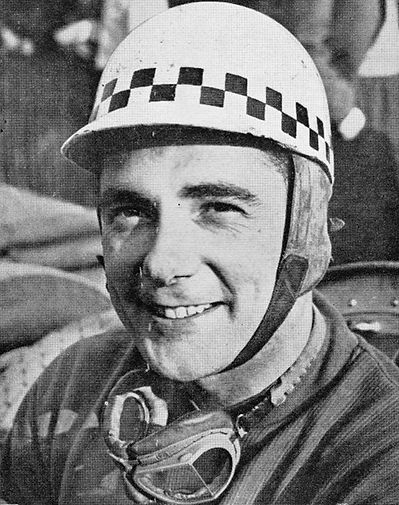
Throughout its history, Formula 1 has seen several drivers of exceptional talent who, for one reason or another, never reached the heights their abilities seemed to promise. In the 1960s it was Chris Amon, in the 1970s Jean-Pierre Jarier, and in the 1990s Jean Alesi. Yet the first name in this unfortunate line, in the very early days of Formula 1, was that of Jean Behra.
Jean Marie Behra was born in Nice, France, on 16 February 1921 to Joseph Behra and Esther Marguerite Tesseire. Unlike the parents of many future Formula 1 stars, his father had no connection whatsoever to the world of motorsport, earning his living as a cinema projectionist, and as a result Jean would have to carve his own path to the pinnacle of racing. His sporting career began in bicycle racing: having received a bicycle as a gift for his fourteenth birthday, Jean quickly mastered it and soon earned a reputation as the finest amateur cyclist in the Alpes-Maritimes department. Becoming something of a local celebrity, Jean found work at a bicycle shop and, a year later, after saving enough money, purchased his first motorcycle — a 125cc Monet-Goyon — thus taking the first step towards a career in motorcycle racing.

Gradually gaining experience and moving on to ever more powerful motorcycles, Jean made his racing debut in 1938, and by 1939 had already achieved his first major success, finishing second in the La Turbie hill climb. At the same time, with his first success, the young Frenchman also found personal happiness: mature beyond his years, he married a seventeen-year-old Italian from Savona, Carla Paola Elsa — better known as Charlotte — and a year later the happy couple welcomed their son, Jean-Paul. Yet the joy of these events was soon overshadowed by the outbreak of the World War II, and for the next five years, Europe was transformed into a vast theatre of war, leaving no place for motor racing.
Yet scarcely had the last shots faded when Jean was among the first to be back in the saddle, and by September 1945 he had already secured his first major victory in the Grand Prix of Liberation of Nice, beating the top French motorcycle racer of the day, Georges Monneret.

As it would soon become clear, this victory was merely a prelude to greater achievements, and in the years that followed Behra dominated France’s motorcycle racing scene, winning the national 500 cc title four times in succession between 1948 and 1951 with Moto Guzzi.

Having achieved everything one could possibly dream of in motorcycle racing, Behra decided to try his hand at motorsport, and by 1949 he was given the opportunity to do so. After winning the Mont Ventoux hill climb on a motorcycle, he entered a car event on the same day, and at the wheel of a Maserati 4CL immediately caused a sensation, setting the fastest time in his class. Buoyed by this success, the Frenchman tried his hand at a more serious contest a month later — the Grand Prix du Salon at Montlhéry — and once again he did not disappoint, securing a very respectable sixth place in a Talbot-Lago 26C. His next experience in motor racing came at the 1950 Monte Carlo Rally, where, partnered with Julio Quinlin, he once again put in a superb performance, finishing third.

However, motorcycle racing still remained his main occupation at the time, and in 1950 he was given only one further opportunity to drive a racing car — at the famous 24 Hours of Le Mans. Partnered by Roger Loyer at the wheel of a Simca-Gordini T15S, Behra did everything he could to prove himself at the Sarthe, but by lap 50 their car began to suffer ignition problems, which eventually forced the French crew to retire. Nevertheless, Jean’s efforts made a strong impression on Amédée Gordini, and the following year, 1951, the French “Sorcerer” gave him a place as a reserve driver in his team, both in Formula 2 and in sports car racing.

In single-seaters, Behra enjoyed some respectable results, taking third place at the Grand Prix des Sables d’Olonne and repeating the feat at Cadours. By contrast, sports car racing proved far less successful: in just two outings, including the 24 Hours of Le Mans, the Frenchman failed to see the finish in either.
Meanwhile, in 1951, the Frenchman also made his Formula 1 debut, although his appearance was so brief that it offered little opportunity to showcase his true potential. At the Italian Grand Prix, one of the team’s regular drivers, Maurice Trintignant, was struck down by indigestion on race day, prompting Amédée Gordini to hastily put Jean behind the wheel. To avoid losing the starting money, however, the “Sorcerer” did not inform the organisers of the driver change, and Behra even had to start in Trintignant’s helmet to prevent the deception from being discovered. In the end, all these efforts came to nothing: after spending most of the race in tenth place, he failed to reach the finish, retiring on lap 30 with engine trouble.
Meanwhile, having secured his fourth and final title in the French motorcycle racing championship in 1951, Behra finally set aside his bike in order to devote himself fully to motorsport, and in 1952 he became a full-fledged member of the Gordini team. Alongside Jean, the French outfit’s main lineup at the time also included the aforementioned Maurice Trintignant and Robert Manzon, and the trio soon earned a reputation as the modern-day Three Musketeers of motor racing.

It is worth noting, however, that Jean entered the top tier of motorsport at an ideal moment: in 1952 the World Championship adopted Formula 2 regulations, which greatly enhanced Gordini’s competitiveness and enabled the Frenchman to showcase his talent immediately against the best drivers in the world.
The 1952 season began for Behra with non-championship Formula 2 events in his native France, where he finished third at Pau and sixth in Marseille. Meanwhile, his first full World Championship appearance came at the Swiss Grand Prix, where he immediately demonstrated both his talent and exceptional fighting spirit. Starting seventh on the grid, Jean quickly made up several places before engaging in a fierce battle for third with former Gordini driver André Simon, who had joined Ferrari that year.

In the end, the battle went in Behra’s favour: on lap 22 Simon was forced to pit and hand over his car to Nino Farina, who would later retire with mechanical problems. However, Jean himself was also far from untroubled — twenty laps from the finish, his car developed a cracked exhaust pipe, and hot gases began seeping directly into the cockpit, burning his legs. Unable to resolve the issue during his pit stop, the Frenchman had no choice but to push on gritting his teeth, and his courage was ultimately rewarded with a superb third-place finish.
Meanwhile, the break between the first and second rounds of the World Championship lasted more than a month, but Jean did not remain idle — he took part in a non-championship Formula 2 race at Aix-les-Bains, where, in the absence of the Ferrari drivers, he comfortably claimed his first victory. Two weeks later, the championship resumed in Belgium for the second round, which carried the honorary title of the European Grand Prix, and there the Frenchman once again proved himself a true fighter. Qualifying fifth, Jean quickly moved up to third in the opening metres before overtaking two Ferraris driven by Alberto Ascari and Nino Farina in quick succession, thus completing the first lap in the lead.

However, scarcely had the two Italians recovered from such an audacious onslaught when they promptly put the bold newcomer in his place, after which a third Scuderia driver, Piero Taruffi, took up the chase. Like Behra, Taruffi had many motorcycle racing victories to his name and resorted to every trick he knew in an attempt to pass the young Frenchman, but Jean defended so masterfully that he left his rival virtually no opportunity to attack. In the end, after spending nine laps on the Gordini’s tail, Taruffi finally found a way through and moved ahead, but his joy was short-lived — within a couple of corners, under pressure from Behra, he made a mistake, spun, and went off the track.
.png)
Unfortunately, that mistake also cost Jean the race: unable to avoid the out-of-control Ferrari in time, he collided with his rival’s car and was forced to retire as well.
However, just a week later, Jean was able to put that setback completely behind him, producing what was arguably one of the finest drives of his career. This came at the non-championship Grand Prix de la Marne, held on the high-speed Reims circuit, where the Gordini drivers this time faced the full Ferrari line-up. In qualifying, the Scuderia cars were in a class of their own, comfortably taking first, second and fifth on the grid, while Behra had to settle for fourth. However, as soon as the flag dropped, Jean immediately surged into the lead and set such a blistering pace that even Alberto Ascari, dominant throughout the season, could find no answer to the Frenchman’s speed.

When, after 14 laps, Ascari pitted with an ailing engine, the outcome of the race was effectively decided, and no one could deprive Jean of a well-deserved victory in front of his compatriots. Having lost Jean-Pierre Wimille and Raymond Sommer in previous years, all of France rejoiced that day at the emergence of a new hero, and his nickname — “Jeannot” — along with his distinctive helmet, soon became familiar to every motorsport fan.

Jean’s helmet, incidentally, deserves a special mention: whereas most of his contemporaries at the time raced in plain, single-coloured helmets, the Frenchman was among the first to embrace individuality, choosing a design featuring a chequered band on a white background, to which he later added his teams logos.
Meanwhile, just a week after that memorable race at Reims, the French Grand Prix took place, and all his compatriots naturally hoped that their new hero would be able to repeat his remarkable success. Living up to expectations, Jean once again delivered a strong qualifying performance, taking fourth place behind the three works Ferrari drivers, but the race itself proved a major disappointment. Unable to gain any positions at the start, Behra soon found himself once again battling Piero Taruffi, and this time, under pressure from the Italian, it was Jean who made the mistake that led to a spin, an unscheduled pit stop, and a significant loss of positions.

And although Jean fought hard to make up for the lost ground, the cost of that mistake proved too high — he eventually crossed the line only seventh.
After missing the following British round due to a shoulder injury sustained during practice for the non-championship Grand Prix de Sables d’Olonne, Behra soon returned to action at the German Grand Prix, where he would face the legendary Nürburgring for the first time. Starting 11th, he rose to the challenge, avoiding a dangerous early collision with Felice Bonetto, whose car had spun across the track, and brought the car home in a solid fifth place, adding another two points to his tally.

However, he was unable to consolidate his progress over the final two rounds in the Netherlands and Italy: at Zandvoort, his Gordini was struck by magneto failure, while at Monza the valve train let him down.

Be that as it may, Jean secured a very respectable ninth place in the 1952 World Championship standings, and while he was outscored by the more experienced and consistent Robert Manzon, Amédée Gordini could hardly conceal his delight at the performances of his promising newcomer.
At the same time, the Frenchman's results in sports car racing were less impressive: his best finish in 1952 was fourth in the Coupes de Vitesse, while at the 24 Hours of Le Mans he once again failed to see the finish, this time because of brake failure.

At the final race of the season, the Carrera Panamericana in Mexico, the Frenchman was involved in a crash so severe that he narrowly escaped with his life. Having led the race after the first day of competition, Behra pushed to the limit during the second stage of the 3,500-kilometre route in an attempt to build a maximum lead over his rivals, but near Puebla he overcooked one of the corners, ran off the road, and plunged straight into a ravine.

Remarkably, after the car rolled several times and came to rest in a ravine as a twisted heap of metal, the Frenchman not only survived but emerged relatively unscathed, suffering “only” seven broken ribs. However, as time would show, this episode was merely the first example of Jean’s remarkable resilience — throughout his racing career he would find himself in serious incidents more than once, yet he always rose like a phoenix, continuing to astonish rivals and fans alike with his fearless bravery and unwavering love of motorsport.

Meanwhile, the off-season before the 1953 campaign proved unusually short, and by January Behra was already back behind the wheel for the inaugural Argentine Grand Prix. Still suffering from pain in his ribs, Jean was unable to show his true pace and could manage only sixth place at the finish, however, the Frenchman’s modest result concerned Amédée Gordini far less than an incident involving Robert Manzon. Running strongly throughout the race, Robert experienced a frightening moment on lap 68 when a wheel suddenly came off his car, and only his composure and lightning-fast reactions allowed him to keep the machine under control and avoid a serious accident.

Considering that this was not the first such incident — something similar had happened to him six months earlier at the German Grand Prix — it proved to be the final straw for Robert, who parted ways with Gordini without hesitation, leaving Behra and Trintignant to settle between themselves who would become the leader of the French team. It was from this moment that the long-running rivalry between the two Frenchmen for the unofficial title of the nation’s finest driver truly began, a contest that would ebb and flow throughout the decade.

In 1953, that distinction rightfully belonged to Trintignant; however, it should be noted that the two Frenchmen were not competing on entirely equal terms. Barely recovered from his injuries in Mexico, Behra was involved in another serious accident in the spring during a non-championship Formula 2 race at Pau, suffering a broken arm and a displaced vertebra. Naturally, these new injuries inevitably affected Jean’s subsequent performances, and combined with Gordini’s persistent mechanical troubles, they resulted in a season in which he failed to score a single championship point.

As for Trintignant, he, by contrast, distinguished himself admirably in the unequal battle against the Ferrari and Maserati drivers, and by scoring points twice he ultimately secured a place in the championship’s top ten. The reward for Maurice’s efforts was an invitation from the Commendatore himself to drive for the Scuderia the following year, while Jean, after Trintignant’s departure, inherited the role of undisputed leader of the French team.

The 1954 season marked a new chapter in the history of Grand Prix racing: after two years run under Formula 2 rules, the World Championship returned to Formula 1 regulations, with the maximum engine capacity increased to 2.5 litres. The introduction of the new formula attracted prestigious manufacturers such as Mercedes-Benz and Lancia, while, naturally, Ferrari and Maserati were not to be left behind, both preparing entirely new cars for the coming season. Against such opposition, Amédée Gordini’s efforts appeared far more modest: working with a severely limited budget, the Sorcerer confined himself to upgrading the engines, leaving the T16’s chassis largely unchanged.

As a result, the French cars were significantly inferior in technical terms to those of their rivals, leaving Behra, in effect, to carry the team on his own shoulders.
As in the previous year, the season opened in Argentina, and it did not begin well for Jean: starting only 16th, he lost control in torrential rain and ran off the track, after which he was disqualified for receiving outside assistance.

However, by the spring things began to improve for the Frenchman, and he started to deliver truly outstanding results, the first of which was victory in the non-championship Pau Grand Prix — on the very same circuit where he had suffered a severe accident the year before. In this race, Jean’s main rival was his former teammate Trintignant, and although he had the faster Ferrari at his disposal, it was Behra who emerged victorious from the duel: his unbreakable will to win and exceptional car control proved decisive.

A month later, Jean struck again, taking second in the BRDC International Trophy, followed shortly afterwards by another podium finish at the non-championship Bari Grand Prix.

However, once the Grand Épreuves began, fortune once again turned its back on the Frenchman.
The second round of the World Championship was held in Belgium at the high-speed Spa-Francorchamps circuit, where Behra and Trintignant once again found themselves side by side, continuing their unofficial rivalry.
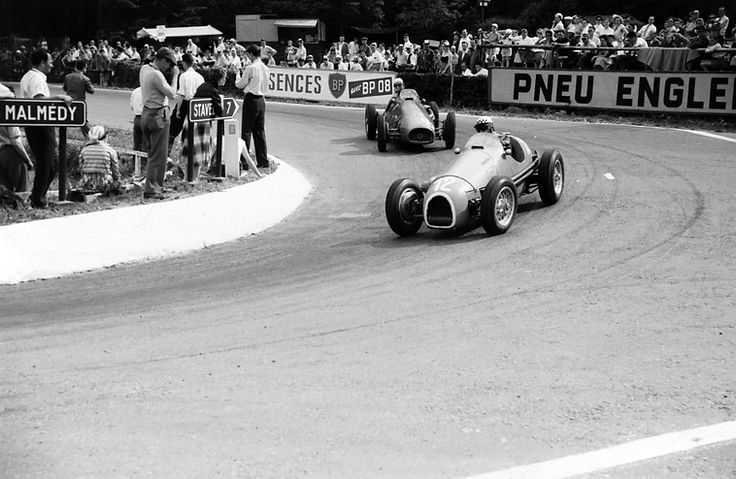
Starting from seventh on the grid, Jean quickly moved into the points in the early stages of the race and entered into a fierce battle with his compatriot; however, their duel was short-lived — on lap 13, Behra was forced to retire with rear suspension failure.
The championship then moved on to the French Grand Prix, a home race for Gordini, on which both Amédée and Behra placed high hopes, but once again they were not fulfilled — this time due to the Frenchman himself. Starting from the back of the field, Jean made a spirited start and had already climbed to sixth place by lap 20, when he once again came up against his former teammate, who had become a persistent stumbling block in his path.

Catching Trintignant and sitting on his tail, Jean attempted to outbrake him at the end of the long straight but failed, running off the track and damaging the nose of his car. Later, during his pit stop, his fiery temperament worked against him: unable to watch a mechanic struggle with a stubborn bonnet, Jean jumped out of the cockpit and decided to handle it himself, only to stall the engine and lose further time. Needless to say, after such a mishap there was no hope of a strong result, and the Frenchman ultimately brought the car home in last place.
Meanwhile, the next stop on the championship calendar was the British Grand Prix at Silverstone, where yet another disappointment awaited Jean. Starting fifth, the Frenchman spent most of the race running comfortably in that position, only for another rear suspension failure to bring his race to a premature end. His sole consolation was a share of the fastest lap, which he recorded jointly with six other drivers.

Things were no better for the Frenchman at the German Grand Prix: almost from the very start of the race, the engine in his Gordini began to misfire, forcing him into an early pit stop and effectively ending any hopes of success.
Meanwhile, Behra’s hopes of at least salvaging a successful end to the season also came to nothing. In the three Grands Prix that followed, he failed to reach the finish on every occasion due to mechanical problems, and as a result, he finished last in the final standings with just 0.14 points to his name — an unenviable record in Formula One history.

Fed up with Gordini’s endless mechanical failures, Behra decided at the end of the season to part ways with the Sorcerer and seek out a new team, eventually finding a home at Maserati. With the promising Luigi Musso and the experienced Roberto Mieres already in its ranks, the Modena outfit was in urgent need of a new leader to replace the departed Juan Manuel Fangio, and the hard-charging Frenchman seemed perfectly suited to the role.
For Behra himself, the move to the Italian team was a godsend. In addition to the status of number one driver and the excellent Maserati 250F — a car of truly immense potential — Jean was offered a salary far beyond the modest sums he had earned at Gordini. As the Frenchman, who lived for racing, later recalled, the moment he saw the figure written into the contract, he could not help but think: “My God, they’re not only giving me a superb car — they’re actually paying me to drive it!”

Behra’s debut for his new team came at the Argentine Grand Prix, which traditionally opened the season, but it could hardly be described as a successful one. After beginning the weekend with a strong fourth place in qualifying, Jean made a poor start and immediately dropped to seventh, while his attempt to fight back quickly ended in contact with another car, a spin, and retirement from the race.

He was, however, given a chance to continue the race at the wheel of Harry Schell’s car — in those days, Formula One regulations allowed drivers from the same team to share cars — but this second opportunity proved no more successful than the first. Struggling in the oppressive heat that had descended on Buenos Aires, Behra was unable to hold on to the third place he had inherited from his teammate and, after spinning several more times during the race, eventually finished only sixth.
However, the Frenchman soon put that disappointment behind him, claiming victory in the non-championship Pau Grand Prix, which was soon followed by another win at Bordeaux.

At the second round of the championship in Monaco, Jean came within touching distance of his first Grand Épreuve victory. Making his first appearance on the legendary street circuit, Behra immediately felt at ease and demonstrated excellent speed, securing fifth place in qualifying.

In the race itself, the Frenchman was even more assured, and after overtaking two Lancias driven by Alberto Ascari and Eugenio Castellotti in quick succession, Jean established himself in third place, behind the two Mercedes of Juan Manuel Fangio and Stirling Moss.

At the same time, the Silver Arrows, virtually unbeatable that season, suffered their only setback of the year at that very race, retiring with mechanical issues and thereby allowing their rivals to take a single Grand Prix victory. Unfortunately for Jean, he too was unable to reach the finish that day due to engine problems, while, in a cruel twist of fate, the Monaco victory went to none other than his long-time rival Trintignant!

Meanwhile, the next round of the championship was the Belgian Grand Prix, which also proved far from successful for the Frenchman. Starting fifth, Behra made a mistake on lap 4, spun off the track, and ended up in a ditch, where his car became hopelessly stuck in the nearby undergrowth.

However, the Frenchman showed no intention of giving up: walking back to the pits, he unceremoniously climbed into Mieres’ car and ultimately brought it home in fifth place, scoring another point in the process.

A week after the race at Spa, Jean arrived at the Sarthe circuit to take part in the 24 Hours of Le Mans — an event that would forever enter motorsport history as the scene of the most horrific catastrophe, claiming the life of Behra’s compatriot Pierre Levegh and more than 80 spectators.

However, the Frenchman never took the start of that fateful race: during practice, he was accidentally run over by one of the DB drivers, leaving him with a leg injury that forced him to withdraw from the event.
The effects of that injury were also felt at the next round — the Dutch Grand Prix, held just a week after Le Mans. Starting sixth, Jean ran in fourth place for much of the race, but pain in his injured leg and a temperamental rear suspension gradually forced him to ease off, and he eventually finished only sixth.

Meanwhile, by the time of the next round in Great Britain, Jean had already fully recovered and immediately showed his true form, securing an excellent third place in qualifying.

However, he was unable to repeat that achievement in the race: as early as lap 10, smoke began pouring from beneath the bonnet of his Maserati, signalling engine failure and yet another missed opportunity to reach the podium.
The final round of the 1955 championship was the Italian Grand Prix at Monza, where Jean took the start in a modified Maserati 250F fitted with a fully streamlined body.

This race proved quite successful for the Frenchman — despite a poor start and an engine failure on the very last lap, Jean still managed to cross the finish line in fourth place, thereby adding a few more points to his tally.

Although Behra finished only eighth in the championship standings, behind even his teammate Mieres, the management of the Modena team was quite satisfied with the Frenchman’s performances, particularly in light of his achievements in sports car racing. Indeed, 1955 proved to be a genuine breakthrough year for Behra in that discipline: at the wheel of the Maserati 300S, he claimed victories in the Bari and Portuguese Grands Prix, as well as in the Supercortemaggiore and the 500 Kilometres of Nürburgring.

However, even amid these successes there was a darker moment: in one of the final races of the season — the Tourist Trophy at Dundrod — Jean was involved in yet another serious accident, suffering a broken arm, torn tendons in his right hand, and the loss of his right ear, severed by a fragment of his shattered goggles.

Nevertheless, the irrepressible Frenchman managed to find humour even in such a serious injury: equipped with a remarkably lifelike prosthetic ear, Behra took great pleasure in startling people by nonchalantly removing it from his head—and nowhere was the trick more effective than in packed restaurants, where a vacant table appeared almost instantly.
Meanwhile, at the end of 1955, the motor racing world was shaken by sensational news whose significance was difficult to overstate: in the aftermath of the Le Mans tragedy, Mercedes announced its withdrawal from motorsport, and suddenly two of the era’s greatest drivers — the World Champion Juan Manuel Fangio and the runner-up Stirling Moss — found themselves on the driver market. After weighing their options for a couple of weeks, the former teammates ultimately went their separate ways: the Argentine moved to Ferrari, while the Englishman signed for Maserati. With the arrival of the British star, Behra was forced to relinquish his status as the team’s number one driver; yet it was in the role of second driver that the Frenchman went on to enjoy the finest Formula One season of his career.

The 1956 season got off to an excellent start, with Behra scoring a superb second-place finish at the Argentine Grand Prix, soon followed by another podium in Monaco.

Thanks to these results, the Frenchman unexpectedly found himself leading the championship early in the season and, although he would later surrender the top position to the Ferrari drivers, three further podium finishes in France, Great Britain, and Germany still left him with a realistic chance of finishing the year in the top three.

For Maserati’s designated leader Moss, the season proved a far more difficult ordeal: although he claimed an emphatic victory in Monaco, persistent reliability issues kept the Englishman out of serious championship contention, and by the time of the final round he found himself only fourth in the standings, behind even his own teammate. The final race at Monza nevertheless put everything into perspective: by taking another victory, Stirling secured the runner-up spot in the championship for the second year in a row, while Behra was left to settle for “only” fourth place overall.

Be that as it may, the year did indeed prove to be the most successful of the Frenchman’s career, a fact reflected not only in his Formula One results but also in his performances in sports car racing. At the wheel of the Maserati 300S and 200S, Jean claimed victories in the 1000 Kilometres of Nürburgring, the 1000 Kilometres of Paris, the Bari Grand Prix and the Rome Grand Prix, while also finishing on the podium on numerous occasions in events ranging from the picturesque circuits of France to the unforgiving roads of South America.

Meanwhile, the end of 1956 brought further reshuffling of team line-ups, and Stirling Moss, who had always dreamed of success in British machinery, left Maserati to join the rapidly rising Vanwall team. With the Englishman’s departure, Jean briefly saw a chance to regain his status as Maserati’s number one driver; however, it was not to be. After failing to reach an understanding with the Commendatore, none other than the great and formidable Juan Manuel Fangio returned to the Modena team, by then already a four-time World Champion.

The Frenchman’s partnership with the great Argentine got off to a flying start: capitalising on gearbox problems suffered by the Ferrari drivers, Fangio and Behra secured a dominant Maserati one-two at the opening round of the championship, which, as usual, took place in Argentina.

However, after such a promising start, Jean’s fortunes took a sudden downturn. Following a crash in practice for the Mille Miglia sports car race, he injured his wrist and was forced to miss the second round at his favourite circuit in Monte Carlo. Returning to action at the French Grand Prix, Jean immediately impressed with a superb second-place qualifying effort, but in the race itself he was unable to withstand the pressure from the Scuderia drivers, while an exhaust failure ultimately ruined his chances of scoring valuable points.

Meanwhile, as Behra struggled with a string of setbacks, Fangio dominated the opening three Grands Prix of the season and was already racing towards what would become his fifth world title.

Be that as it may, the Frenchman refused to be discouraged, and at the very next round in Great Britain he proved that he was far from finished. Once again producing a superb qualifying performance, Jean secured second place on the grid and, on this occasion, even outpaced his illustrious teammate, who could manage only fourth.

When the race got underway, Behra comfortably held on to second place, and as Moss ran into trouble with his Vanwall, the Frenchman moved into the lead and seemed to be on course for his first Grand Épreuve victory.

Yet with only 20 laps to go and a lead of more than 20 seconds, disaster struck: the Frenchman’s transmission blew apart on the main straight, and another golden chance was gone forever.

Meanwhile, the next round was held at the Nürburgring in Germany, where Fangio arguably produced the greatest drive of his career, overcoming a lengthy pit stop to recover what had seemed a hopelessly lost victory from the Ferrari drivers and thereby clinching his fifth and final world title.

For Behra, however, the Grand Prix brought yet another disappointment. Forced to pit for tyres and refuelling like the Argentine, he damaged the fuel filler cap in the process and, after losing a great deal of time on repairs, eventually finished only sixth.

The final two rounds were held on Italian soil, and unfortunately they brought no success for Jean: at Pescara, the Frenchman lost what looked like a certain podium due to a ruptured oil line, while at Monza he was let down by an experimental 12-cylinder car suffering from chronic overheating.
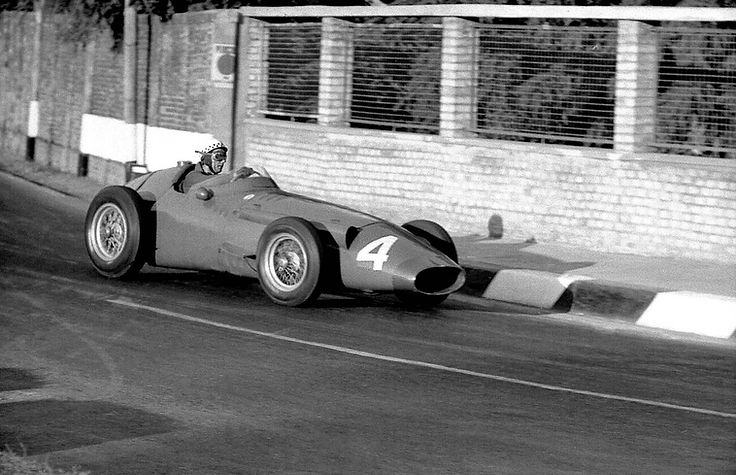

Not surprisingly, after so many setbacks, Behra’s 1957 World Championship campaign ended in disappointment: just a single podium, taken in the opening round in Argentina, and ninth place in the overall standings. At the same time, his results outside the championship were far more impressive: in non-championship Formula One races he scored victories at Pau, Caen, the BRDC International Trophy, Modena and Morocco, while in sports car racing he triumphed at the 12 Hours of Sebring and the Swedish Grand Prix.
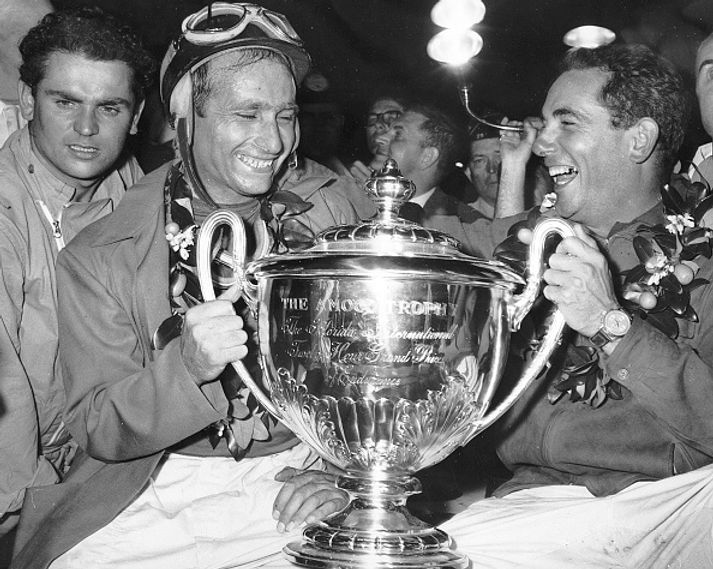
Meanwhile, Maserati’s celebrated triumphs in Formula One and sports car racing concealed the company’s increasingly precarious financial position, and by the end of 1957 the Modena marque was forced to withdraw the famous Trident from motorsport in order to ensure its survival. Unsurprisingly, the decision struck a heavy blow to everyone at Maserati, with Fangio and Behra among those most affected, as they had long considered the Italian outfit their second home. For the great Maestro, Maserati’s withdrawal effectively marked the end of his career: at the age of 46 and with five World Championship titles to his name, Fangio no longer sought a new team, and after a few outings as a private entrant he finally decided to hang up his helmet. Behra, however, then at the peak of his form, was still far from contemplating retirement and remained hungry for further victories. In the end, the Frenchman chose to sign with BRM: although the British team had yet to achieve major success in Formula One, its progress was clear, and Jean was already familiar with the qualities of the P25, having won the 1957 Caen Grand Prix and the International Trophy in those very cars.

At the same time, at the opening round of the 1958 season in Argentina, Jean once again took the start in a Maserati: his new team had chosen not to incur the expense of an overseas trip, and as a result the Frenchman was obliged to turn to Ken Kavanagh, who placed one of the last Modena-built cars at his disposal. As in the previous year, the race in Buenos Aires was run in extreme heat, and, battling with Fangio, Hawthorn and Moss for a place in the top three, Behra once again demonstrated his finest fighting qualities.

Unfortunately, heavy tyre wear and an unscheduled pit stop prevented the Frenchman from opening his season with a podium, though he still salvaged a couple of points with fifth place.
Meanwhile, Behra’s debut for Alfred Owen’s team came at the second round in Monaco, where on the narrow streets of Monte Carlo he once again demonstrated his considerable talent, emerging as one of the standout performers of the weekend.

Having qualified in a superb second place, Behra made an excellent start to the race, immediately taking the lead and, for the next 27 laps, confidently heading the field, giving the Ferrari and Vanwall drivers no chance to move ahead.

Yet once again, reliability proved decisive: betrayed by his brakes, the Frenchman was ultimately forced to retire in the pits, while—astonishingly, just as three years earlier—the victory went once again to his old rival Trintignant!

Meanwhile, at the next round in the Netherlands, BRM once again demonstrated excellent form, and a double podium was the deserved reward, with the team’s drivers finishing behind the race winner, Moss.

Although Jean shared in the team’s delight at the result, the success was tinged with a degree of disappointment: having finished third, he crossed the line almost a minute behind his teammate Harry Schell — the very same driver who had joined BRM alongside him from Maserati and whom he had comfortably outperformed throughout the previous season. It soon became clear, however, that Owen’s team was simply incapable of achieving much more that year, and the Frenchman’s hopes of challenging Ferrari and Vanwall remained little more than a dream. Indeed, even scoring points proved a difficult task for Jean, largely due to the chronic unreliability of the Bourne-built machines: in Belgium he retired with an overheating engine, in France a fuel pump failure cost him a certain podium, while in both Britain and Germany suspension problems brought his races to an early end.

In the end, Jean would score points just once more that season, at the street circuit of Porto, where his efforts finally paid off with a fourth-place finish.

The final two Grands Prix of the season, in Italy and Morocco, brought no better fortune for the Frenchman, and as a result Behra ended the championship outside the top ten, having been beaten by his teammate Harry Schell in their intra-team contest.

Nevertheless, the Frenchman’s fortunes in sports car racing remained undiminished. Having traded Maserati machinery for German-built Porsches, Behra claimed victories in the 3 Hours of Rouen, the Rheinland Nürburgring and the Berlin Grand Prix during 1958, while also collecting podium finishes in the Targa Florio, at Zeltweg, and in the 24 Hours of Le Mans.

Meanwhile, despite his deeply disappointing results in Formula One, Jean still hoped that better days lay ahead, and the beginning of 1959 indeed brought a truly career-defining moment: Enzo Ferrari himself telephoned to offer him a full-time drive with the Scuderia. The Commendatore’s motives were perfectly understandable. Following the deaths of Luigi Musso and Peter Collins, as well as Mike Hawthorn’s retirement, the Maranello team had effectively been left without any established leading drivers, and Jean’s name was naturally among the first to be considered. Given the opportunity of a lifetime, Behra wasted no time in signing the contract, secretly hoping that the Ferrari 246 Dino — the very car that had carried Hawthorn to the world title — might do the same for him.

The Frenchman’s first outings in Scuderia colours appeared to confirm all his hopes. Partnering Cliff Allison in the 12 Hours of Sebring, he finished an impressive second, before soon securing his first victory for Ferrari in the non-championship Formula One race, the BARC Aintree 200.

Buoyed by these early successes, Jean approached the upcoming World Championship full of optimism and looked forward especially to the opening round of the season, which that year took place at his beloved Monte Carlo. The weekend in the famous principality could hardly have begun better: in practice he was more than a second faster than his new teammates, Tony Brooks and Phil Hill, and comfortably secured second place on the grid, beaten only by Stirling Moss in his Cooper.

The race got off to an equally promising start for the Frenchman: making a clean getaway from the front row, Behra used his engine’s superior revving characteristics to snatch the lead at once, leaving Moss and Brabham in pursuit. However, that was where the good news ended for the Frenchman: no matter how hard he pushed, he could not shake the two Coopers from his tail, a clear sign that the Surbiton machines were now fully the equal of the Maranello cars.

Nevertheless, exploiting the difficulty of overtaking on this street circuit, Behra managed to hold off all attacks from Moss and Brabham for 20 laps, and might well have held that position all the way to the finish. However, sadly, it was not to be: on lap 25 the Frenchman’s engine suddenly failed with a loud bang, and his hopes of victory in Monaco once again came to nothing.

Nevertheless, there was little time for the Frenchman to dwell on disappointment: within two weeks, Jean was back at the wheel of a Ferrari 250 TR for the Targa Florio sports car race, and only a week later he was off to the Netherlands for the second round of the Formula One World Championship.

At the same time, from the moment the cars took to the Zandvoort track, it was clear that the British teams had the upper hand, and Behra ultimately had to work hard just to secure a respectable fourth place on the grid. The race itself brought no relief for the Frenchman either: fighting in turn with the Cooper, BRM and Lotus drivers, Jean slipped back through the field and ultimately finished fifth, which in effect proved to be the limit of Scuderia’s performance that day.

Meanwhile, the gap between the second and third rounds of the Formula One World Championship stretched to more than a month, but Jean was far from idle, making yet another attempt to conquer the 24 Hours of Le Mans. Sharing a Ferrari Testa Rossa with American rookie Dan Gurney, he did everything within his power to secure victory for Ferrari and even set the fastest lap of the race; however, their effort ended in disappointment, as an engine failure forced them out before half distance was completed.

Nevertheless, despite this setback, Jean remained determined to strike back at his home Formula One round — a race that carried particular importance for him.
At the time, Scuderia’s internal philosophy was governed by a simple rule: whoever scored the most points across the first three Grands Prix would assume the informal status of team leader and could expect full support from his teammates in the fight for the World Championship. With Behra trailing both Brooks and Hill in the standings at that stage, the French round became a true moment of truth for him, and a major result was more crucial than ever. Confident in his clear speed advantage over his teammates, Jean believed he could deliver the required result, but from the very beginning of the weekend, everything began to go against him.
Opting to use the same hybrid car as in Zandvoort, Jean made his first mistake: while the twisty, slippery Zandvoort circuit had perfectly suited the machine, the long straights of Reims exposed its weaknesses, leaving the advantage instead to his teammates in standard 246s. Having spent the first day of practice struggling with the car and failing to achieve any meaningful progress, the Frenchman eventually switched back to a standard machine as well — but it was already too late: in qualifying he could manage only fifth, while pole position was taken by none other than Tony Brooks. The start of the race was a disaster for Behra: jumping the gun as the national flag fell, his Ferrari immediately stalled, and he rejoined the field dead last, a full hundred metres behind the rest of the pack.

Nevertheless, the setback only spurred the Frenchman on, and to the cheers of his compatriots he immediately set off on a breathtaking charge through the field, which, without doubt, proved to be the highlight of the Grand Prix.

Racing like a hurricane, Jean swept past rival after rival, leaving the crowd in awe of his progress: by lap 10 he was seventh, by lap 20 he had climbed into the points, and by lap 30 he was locked in a desperate fight with Brabham, Moss and Phil Hill for second place. Yet all of Behra’s efforts were in vain: the engine of his Ferrari eventually succumbed to the strain, forcing him to retire in the pits.

Having given everything to the race and watching Brooks cruise to a comfortable victory while his own hopes of Ferrari leadership collapsed before his eyes, Jean climbed out of the cockpit in a state of fury and with a clear sense of having been betrayed.

So, when a conveniently timed journalist from L’Équipe asked him for his comments on the race, Behra did not hold back and told him exactly what he thought of Scuderia Ferrari: that he had been given a car with a twisted chassis and an old engine, and that clear favouritism was being shown towards Brooks within the team. Taking these remarks at face value, the journalist immediately sought clarification from Ferrari manager Romolo Tavoni, who — put on the spot — was forced to personally inspect Behra’s car in order to dispel any doubts of foul play. The story quickly gained wider attention, and by the following day it had reached the Commendatore himself. Enzo Ferrari’s reaction was entirely predictable: he instructed Tavoni to track down the defiant Frenchman at once and secure a public retraction of his statements. However, as might have been expected, nothing good came of the attempt: the meeting between Tavoni and Behra quickly escalated into a heated argument, and after the Frenchman was accused of engine failure being his own fault, Jean finally lost his temper and struck his counterpart in the face. Events then unfolded in the worst possible way for Behra: a few days later he was summoned to see the Commendatore, where he again refused to apologise for either his remarks or his actions, and the consequences of his defiance followed immediately — he was dismissed from the team.
It is difficult to say whether Jean fully understood the possible consequences of his actions at the time, but one thing is certain: it was not long before he regretted going so far. Parting ways with Ferrari, he was effectively left with very few options — his prospects in Formula One were extremely limited, and opportunities with other teams were scarce. Having attempted to negotiate a return to BRM with Alfred Owen, Behra received a polite refusal, as the British outfit was by then already committed to three drivers, leaving no room for the Frenchman. His efforts to purchase one of Ferrari’s 246 cars in order to continue as a private entrant also came to nothing, as the Commendatore, after their acrimonious split, wanted nothing further to do with him. As a result, Behra was left with essentially only one way to continue his career: to compete with two personal Porsches he had acquired from the German manufacturer the previous year. One of these was a 718 sports car, which had brought him a number of successes in 1958, while the second was a 1.5-litre open-wheel racing prototype built by Valerio Colotti using Porsche RSK components and already tested by the Frenchman himself and other drivers in Formula Two competition.

It was these two cars that Behra brought to the next Formula One round at the German AVUS circuit in Berlin. In the main Grand Prix, however, prospects for success were limited: AVUS, essentially a giant two-way autobahn, was one of the fastest circuits in the world, and against full Formula One machinery Behra’s low-powered Porsche was an obvious outsider. Accordingly, Jean focused above all on the supporting sports car race, where — driving identical machinery to the works Porsche entries — he stood an excellent chance of a strong result and of partially rebuilding his reputation after his bitter split with Ferrari.
The race took place on 1 August 1959 and would prove to be the last of the Frenchman’s life. Conditions that day were clearly unsuitable for racing: torrential rain had turned the circuit into a sheet of ice, while the steep northern banking, known as the “Wall of Death”, became a truly treacherous section that left no room for the slightest mistake. Even in the opening laps, several serious incidents occurred: Fritz d’Orey lost control on the exit of the banking and crashed into the area in front of the main grandstand, while a little later Carel Godin de Beaufort spun at the very apex of the turn and, after going over the edge, plunged into the embankment, narrowly escaping serious injury. As for Behra himself, he spent the first laps engaged in a tense battle for the lead with the works Porsche drivers Jo Bonnier and Wolfgang von Trips, but on lap four he too made a mistake.


Losing grip on the slippery banking, Jean’s Porsche spun and headed straight towards the edge of the bend; however, unlike de Beaufort, the Frenchman was far less fortunate: in his path stood a concrete block that had served as the base for an anti-aircraft gun during the Second World War. Striking this obstacle with its rear, the car was crushed almost in half by the tremendous impact, while Behra himself was thrown clear, seemingly lifted into the air above the circuit like a bird.
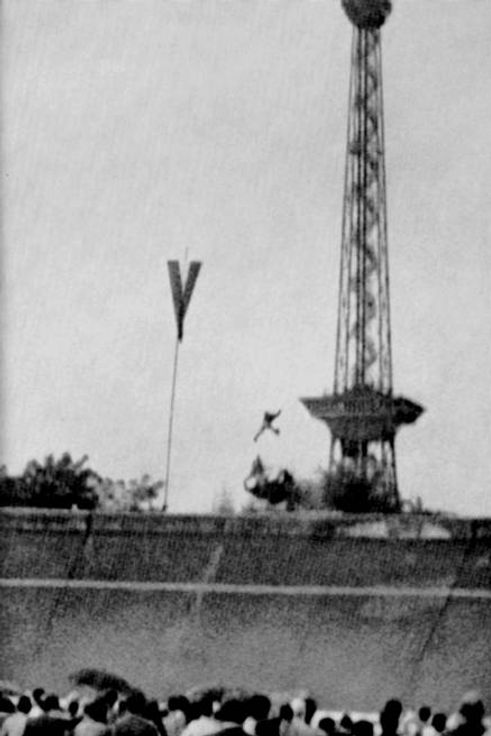
The Frenchman’s final flight lasted only a few seconds: striking a nearby flagpole, he immediately sustained fatal head injuries, and death came almost with the same swiftness with which he had once raced through racing circuits. Having never won a Grand Épreuve, Jean nevertheless remained in the memory of Formula One fans as one of the sport’s most vivid characters, and his name went on to inspire an entire generation of talented French drivers who would make their mark on the circuits two decades later.
