
Presentation of 1960 season
The 1960 Formula One World Championship was the eleventh in the sport’s history and the final season of the 2.5-litre era before new technical regulations came into effect. The points system was also revised for the season, with championship points now awarded to the first six finishers on an 8–6–4–3–2–1 basis, while the additional point for fastest lap was abolished. As the championship calendar once again expanded to nine rounds, only each competitor’s six best results counted towards the final standings of both the Drivers’ Championship and the Constructors’ Championship. The season opened with the Argentine Grand Prix, followed by rounds in Monaco, the Netherlands, Belgium, France, Great Britain, Portugal, Italy and the United States.
Teams
Cooper Car Co
The previous season had marked a true breakthrough for Cooper: their revolutionary rear-engined T51s won five of the eight championship rounds, giving the Surbiton team its first Drivers’ Championship and Constructors’ Championship titles. Yet despite such an impressive success, John Cooper had no intention of resting on his laurels and, together with chief designer Owen Maddock, prepared the T53 car for the new season — a further development of the championship-winning T51. Thanks to its redesigned tubular chassis, the new car was lower and more aerodynamically efficient, earning it the nickname Lowline. The T53 was also equipped with a new in-house five-speed gearbox and a revised rear suspension, in which the transverse leaf spring was replaced by coil springs. As before, power came from the 2.5-litre four-cylinder Coventry Climax FPF engine, whose output had been increased to around 250 bhp through a series of refinements. Equally significant changes took place within the team itself: for the new season, John Cooper decided to concentrate his efforts on just two drivers — reigning World Champion Jack Brabham and the young Bruce McLaren — while the team’s former third driver, Masten Gregory, was forced to seek a seat elsewhere.

Cooper T53 Climax


33-year-old Australian, 1959 F1 World Champion. The previous season proved to be a defining moment for Jack: entrusted with a truly competitive car for the first time in his Formula One career, the Australian delivered a series of outstanding performances and, thanks to victories in Monaco and Great Britain, ultimately emerged victorious in the battle for the World Championship. This year, at the wheel of the even more refined T53, Jack will undoubtedly do everything in his power to defend his crown and prove that last season’s success was no mere coincidence.
Jack Brabham

22-year-old New Zealander who took 6th place in the 1959 F1 World Championship. The previous season saw Bruce make his Formula One debut, and he rightfully earned recognition as the championship’s breakout star. Progressing steadily throughout the year from points finishes to podiums, the New Zealander capped off the season with an impressive maiden victory at the United States Grand Prix, becoming the youngest Grand Prix winner of his time. Having fully justified John Cooper’s faith in him, McLaren retained his place in the team’s regular line-up and entered the new season determined to build on the success of his debut campaign and achieve even greater results.
Bruce McLaren
Scuderia Ferrari
Last year, the Maranello team emerged as Cooper’s principal rival in the battle for the World Championship, but the clear superiority of the British cars ultimately prevented the Scuderia from turning the tide in its favour. As a result, its main achievements were victories on the ultra-fast circuits of France and Germany, together with Tony Brooks’s runner-up finish in the Drivers’ Championship. Having drawn the necessary conclusions from the campaign, the Commendatore recognised the need for change and, under conditions of strict secrecy, instructed chief designer Carlo Chiti to develop Ferrari’s own rear-engined car, designated the Ferrari 246P. The new machine was built around the familiar Ferrari V6 engine, which, in accordance with the new concept, was mounted longitudinally behind the driver. In addition to its rear-engined layout, the car also featured a completely redesigned rear suspension, with the De Dion system replaced by double wishbones. Nevertheless, the proven Ferrari 246 Dino was still expected to remain the Scuderia’s mainstay throughout the 1960 season, while the 246P was intended primarily as an experimental machine for testing technical solutions aimed at the forthcoming 1961 regulations. As for the driver line-up, Tony Brooks’s departure elevated Phil Hill to the role of team leader, while Wolfgang von Trips and Cliff Allison completed the Scuderia’s roster for the new season.

Ferrari 246 Dino


Ferrari 246P


33-year-old American, who took 4th place in the 1959 F1 World Championship. Last year, Phil completed his first full Formula One season, delivering a highly impressive set of results: the American secured three podium finishes — in France, Germany and Italy — and ended the championship in a strong fourth place overall. However, the new season brings even greater ambitions for Hill: to establish himself as the Scuderia’s leading driver, to secure his maiden Grand Prix victory, and to confirm Ferrari’s competitiveness in the fight against the rapidly improving British teams.
Phil Hill

32-year-old German, heir to an aristocratic family, who took 12th place in the 1957 F1 World Championship. Last season, Wolfgang competed for Porsche’s factory team, but the German manufacturer’s main successes came in sportscar racing, while its Formula One programme remained severely limited. Unwilling to waste time waiting for improvements, von Trips chose to return to Ferrari this season, hoping to re-establish himself among the Scuderia’s leading drivers.
Wolfgang von Trips

28-year-old Englishman, who took 14th place in the 1959 F1 World Championship. Last year Cliff completed his first season with the Scuderia, but his status as a reserve driver meant he achieved little success, finishing only 14th in the championship. Nevertheless, for the new season Allison was promoted to a full-time race driver, opening up significantly greater opportunities to prove himself.
Cliff Allison
Owen Racing Organization
The previous season saw Alfred Owen’s long-term development work on the P25 finally bear fruit, as Jo Bonnier’s victory at the Dutch Grand Prix marked BRM’s first major success. However, the Bourne team was unable to build on this achievement, while Cooper’s rapid rise ultimately convinced Owen that the era of front-engined cars was drawing to a close. Unwilling to be left behind by new trends, BRM was among the first teams to begin work on its own rear-engined car, which, designated the P48, made its debut at the previous year’s Italian Grand Prix. Due to extremely tight deadlines, chief designer Stewart Tresilian retained most of the P25’s mechanical components with only minor changes, including even the single rear brake disc, which had already become one of the car’s most controversial features. Nevertheless, the advantages of the P48 were already evident in early testing: the new layout significantly reduced the car’s weight, while the adoption of a rear suspension with double wishbones greatly improved its handling. Significant changes also took place within the team itself: Jo Bonnier was the only driver to retain his seat, while Graham Hill and Dan Gurney joined the Swedish driver as new teammates.

BRM P48


30-year-old Swede, who took 8th place in the 1959 F1 World Championship. The previous season proved to be a landmark one for Jo: at the Dutch Grand Prix he claimed his maiden Formula One victory, which also marked the first win in BRM’s history. However, after such a brilliant breakthrough, the remainder of the campaign was far less successful, and Bonnier ultimately finished only eighth in the championship standings. The coming season, meanwhile, presents the Swede with new challenges: not only must he prove the competitiveness of the new rear-engined BRM P48, but he must also reaffirm his status in the face of promising new teammates.
Jo Bonnier

31-year-old Englishman, competitor in the 1958 and 1959 F1 World Championships. Over the past two seasons, Graham raced for Lotus, but despite all his efforts he failed to score a single championship point in any Grand Prix. Realising that another disappointing season could seriously jeopardise his career, Hill parted ways with Colin Chapman’s team and joined BRM, hoping that his fortunes would finally take a turn for the better.
Graham Hill

29-year-old American, who took 7th place in the 1959 F1 World Championship. Last season, Dan made his Formula One debut with Ferrari and immediately made a strong impression, scoring two podium finishes and ending the championship in seventh place overall. However, despite such a productive partnership, Gurney chose to part ways with the Scuderia at the end of the season and try his luck with BRM, hoping to achieve even greater success with the British team.
Dan Gurney
Team Lotus
Last year, Colin Chapman’s team contested its second Formula One season, but compared with Cooper, Ferrari and BRM — each of which claimed at least one Grand Prix victory — Lotus’s results appeared decidedly modest: just two points-scoring finishes and, consequently, only fourth place in the Constructors’ Championship. Dissatisfied with this state of affairs, Chapman elected to start with a clean sheet and prepared an entirely new car for the coming season — the Lotus 18, the first rear-engined Formula One machine built by the team. Like Cooper’s T53, it was powered by the 2.5-litre Coventry Climax FPF engine, but featured an exceptionally narrow and low-profile chassis, reducing its weight to an impressive 445 kilograms. Equally important was the car’s outstanding handling, achieved through the use of an innovative rear suspension design. Unlike its rivals, the Lotus 18 employed an independent rear suspension with reverse lower wishbones and upper top links, with the driveshafts forming an integral part of the suspension geometry. As for the driver line-up, Graham Hill’s departure elevated Innes Ireland to the role of team leader, while Alan Stacey took over as the team’s second driver.

Lotus 18 Climax

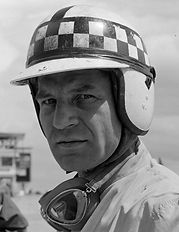
29-year-old Scot, who took 11th place in the 1959 F1 World Championship. Last season, Innes made his Formula One debut with Colin Chapman’s team and, despite being hampered by highly unreliable machinery, managed to score points on two occasions, finishing 11th in the championship standings. With Graham Hill’s departure, Ireland entered the new season as the team’s undisputed leader and, with a new and more competitive car at his disposal, had every chance of achieving far more impressive results.
Innes Ireland

26-year-old Englishman, competitor in the 1958 and 1959 F1 World Championships. Over the previous two seasons, Alan served as a reserve driver for Colin Chapman’s team and, having contested only three Grands Prix, failed to score a single championship point. Nevertheless, Stacey would be promoted to a full-time race seat for the new season, giving him the opportunity to contest a full championship campaign and, for the first time, fulfil his potential.
Alan Stacey
Reventlow Automobiles Inc
Founded by racing enthusiast and Woolworth heir Lance Reventlow, the team would make its Formula One debut in 1960, becoming the first fully American project to compete at the highest level of Grand Prix racing. Having enjoyed considerable success with Scarab sports cars in the United States, Reventlow set his sights on a far more ambitious goal — conquering the circuits of Europe — and devoted substantial time and resources to building an entirely American Formula One car. The technical side of the project was entrusted to young aeronautical engineer Marshall Whitfield, who chose not to follow the latest trends and instead opted for a proven front-engined layout with fully independent suspension. The engine was designed by Leo Goossen, chief engineer at Meyer & Drake Engineering, who based it on the familiar 2.5-litre Offenhauser inline-four and incorporated a number of innovative features, including Hilborn fuel injection and a desmodromic valve system. Nevertheless, the final result proved rather modest, with the engine producing only 220 bhp, leaving it noticeably down on power compared with its principal rivals. Power was transmitted through a four-speed manual gearbox borrowed from the production Chevrolet Corvette and adapted for racing use. The only major component sourced from Europe was the Girling disc brake system, as Whitfield was unable to find a satisfactory American alternative despite extensive testing. Safety also received considerable attention during the car’s development: the Scarab became the first Formula One car to be fitted with both a roll bar and seat belts. The team’s drivers were Reventlow himself and his former teammate Chuck Daigh, with whom Scarab had achieved its greatest successes in American sports car racing.


24-year-old American, F1 World Championship debutant. As heir to the Woolworth fortune, Lance chose a career in motor racing at the age of nineteen and went on to achieve a number of successes in the United States behind the wheel of various sports cars. Following his triumph in the 1958 American championship with the self-developed Scarab, Reventlow decided that the time had come to challenge Europe’s motor racing elite and, in the new season, would bring the first fully American team to Formula One, serving both as its owner and one of its drivers.
Lance Reventlow

36-year-old American, F1 World Championship debutant. Having begun his racing career in the early 1950s, Chuck established himself during the second half of the decade as one of the leading drivers in American sports car racing, with his most notable achievements including victory in the 1958 United States Grand Prix at Riverside and the 12 Hours of Sebring a year later. Possessing not only considerable driving talent but also outstanding engineering ability, Daigh played a significant role in Scarab’s successes in sports car competition and therefore had little hesitation in joining the ambitious Formula One project when Lance Reventlow decided to take the team to Europe.
Chuck Daigh
R R C Walker Racing Team
Last season, Rob Walker’s private team, armed with the championship-winning Cooper T51, the incomparable Stirling Moss and the experienced Maurice Trintignant, emerged as one of the leading contenders for the World Championship, but even victories in Italy and Portugal proved insufficient to secure the title, which instead went to Jack Brabham in the works Cooper. Having drawn the necessary conclusions, Walker parted ways with Trintignant ahead of the new season in order to focus all his efforts on his lead driver, while his new weapon would be the latest Lotus 18, which already appeared noticeably quicker than the Cooper in early testing.

Lotus 18 Climax

30-year-old Englishman, vice-champion in the F1 World Championship in 1955, 1956, 1957 and 1958. Last season, driving for Rob Walker’s team, Stirling claimed two victories and, alongside Jack Brabham and Tony Brooks, was regarded as one of the leading contenders for the World Championship. However, circumstances once again went against him, and Moss ultimately had to settle for third place in the final standings. Nevertheless, the Englishman has not abandoned his dream of winning the coveted title and will make another attempt to achieve that goal in the new season — this time at the wheel of a Lotus.
Stirling Moss
Yeoman Credit Racing (BRP)
Founded by Ken Gregory and Alfred Moss, father of Stirling Moss, British Racing Partnership would contest its first full F1 World Championship season in 1960, fielding a three-car entry. Whereas the team had participated in only a handful of Grands Prix the previous year using front-engined BRM P25s, it now placed its faith in the championship-winning rear-engined Cooper T51 and hoped to take a significant step forward in competitiveness. The team’s colours would be carried by 1959 World Championship runner-up Tony Brooks, who was expected to lead the squad, while the experienced Harry Schell and the young Chris Bristow — one of the most promising British drivers of his generation — completed the line-up. In addition, the arrival of a new title sponsor, Yeoman Credit Ltd., prompted a change of identity, with the team henceforth competing under the name Yeoman Credit Racing.

Cooper T51 Climax

28-year-old Englishman, vice-champion in the 1959 F1 World Championship. Last season, Tony competed for Scuderia Ferrari and, with victories in France and Germany, came close to securing the World Championship title, ultimately missing out by just four points to Jack Brabham. However, never fully becoming part of the Scuderia, Brooks chose at the end of the year to return to his roots and continue his career with British teams, and with hopes of the Vanwall comeback finally fading, he accepted an offer from Yeoman Credit Racing to become the new team leader.
Tony Brooks

39-year-old American, who took 6th place in the 1958 F1 World Championship. Last season marked Harry’s second year with BRM, but its results could hardly be described as successful: newcomer Jo Bonnier clearly outperformed him, while Schell managed only two points-scoring finishes and ended the championship in tenth place overall. Unable to meet Alfred Owen’s expectations, Harry was forced to give way to the more promising Graham Hill and Dan Gurney; nevertheless, his experience and speed remained highly valued in the paddock, and he would now join Yeoman Credit Racing as its second driver.
Harry Schell

22-year-old Englishman, F1 World Championship debutant. Having begun his racing career at the age of 18 in club events, Chris quickly established himself as one of the fastest and most determined drivers of his generation, and his performances brought him to the attention of BRP, where he became one of the team’s regular drivers in 1959. After winning the John Davy Trophy and finishing second in the British Formula Two Championship, Bristow proved that the team had made the right choice, and he now enters Formula One this season, taking the next step in his career.
Chris Bristow